AccueilGuides d'AmsterdamAmsterdam Canal Houses: History & Architecture by Boat

Neighbourhoods & Routes

Amsterdam Canal Houses: History & Architecture by Boat

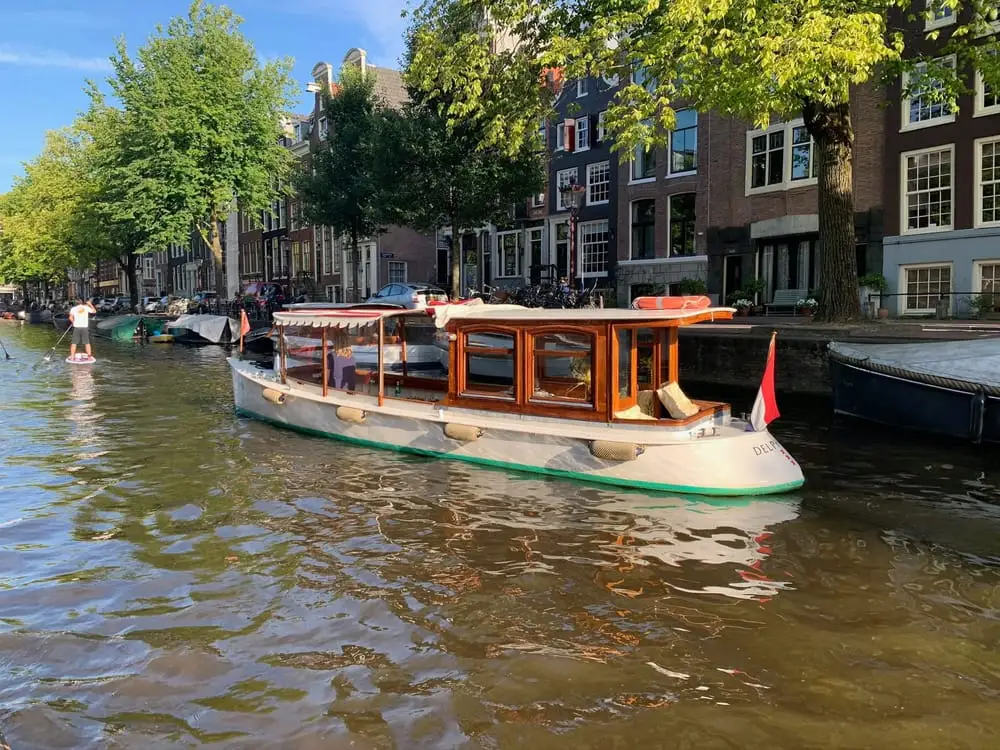
Amsterdam's canal houses are more than pretty façades — they are physical records of 400 years of Dutch commercial history, engineering ingenuity, and aesthetic evolution. From the water, you can read them like a timeline: the narrow 17th-century step-gables, the wider 18th-century neck-gables, the neoclassical bell-gables of the merchant class. Every hook projecting from the top floor tells you the building was once a warehouse. Viewing these houses by boat, at canal level, gives you the perspective their builders intended, according to the UNESCO World Heritage Centre.

Why Canal Houses Are Narrow and Tall

Canal houses are narrow because frontage on the water was valuable and taxes were linked to the width of a plot. The response was to build upward: a compact façade, several floors, steep internal stairs and an attic hoist for furniture and merchandise. Look at the roofline for the beam and hook. A façade that leans forward may have been intentionally built with clearance for lifting goods; a house that leans left or right is more likely showing movement in the ground and its foundations. Those are two different things, according to the Museum of the Canals.


Shared Off The Beaten Path, Hidden Gems Canal Cruise

Compagnies présentées dans ce guide

Bow's JourneysOff CoursePrivate Boat Tour AmsterdamCV XR Visuals Factory
Shared cruise
Shared Off The Beaten Path, Hidden Gems Canal Cruise

€35per person

Up to 121 hour & 30 minsRain protected
Tue22Sep
Today
Wed23Sep
Tomorrow
Thu24Sep
Fri25Sep
Sat26Sep
Sun27Sep
Mon28Sep
Tue29Sep
Wed30Sep
Thu1Oct
More
dates
More info →

Reading the Gables: A Field Guide

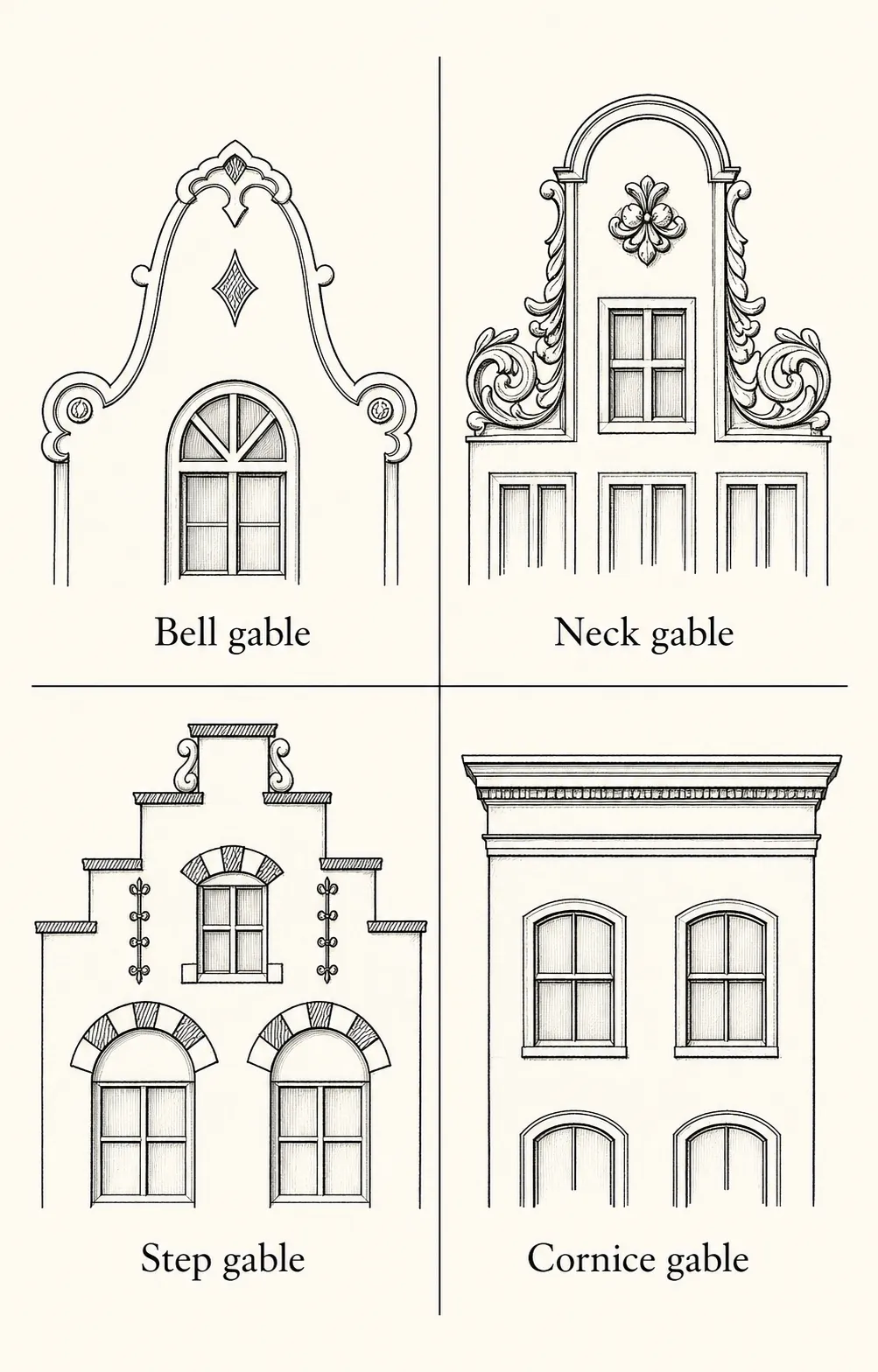
Architectural illustration showing four Dutch gable types: bell gable, neck gable, step gable, and cornice gable

These four gable styles define the silhouette of Amsterdam's canal ring.

The gable is the shaped top above a canal-house façade. It is the easiest architectural clue to read from a boat—but it is a clue, not a date stamp: many façades were rebuilt or changed over the centuries. Look for the staircase outline of a stepped gable, common in the first half of the seventeenth century; the narrower neck gable; the curved bell gable; and the straight-topped cornice gable. Spout gables were particularly practical on warehouses, where goods were lifted into the attic.

Learning these silhouettes gives you a way to read a whole stretch of canal in minutes. From a boat the whole row lines up. On the quay you are standing almost underneath the houses and looking steeply up, which foreshortens the roofline and makes a stepped gable and a bell gable read much the same. Out on the water the angle flattens and the crowns appear in sequence, side by side, which is when the differences become obvious, according to the Museum of the Canals' architecture guide.

Amsterdam Historic Boat TourPrivate boat
Amsterdam Historic Boat Tour

€440starting from

Up to 101 hour & 30 minsRain protected
Tue22Sep
Today
Wed23Sep
Tomorrow
Thu24Sep
Fri25Sep
Sat26Sep
More info →

The Golden Bend: Amsterdam's Billionaire's Row

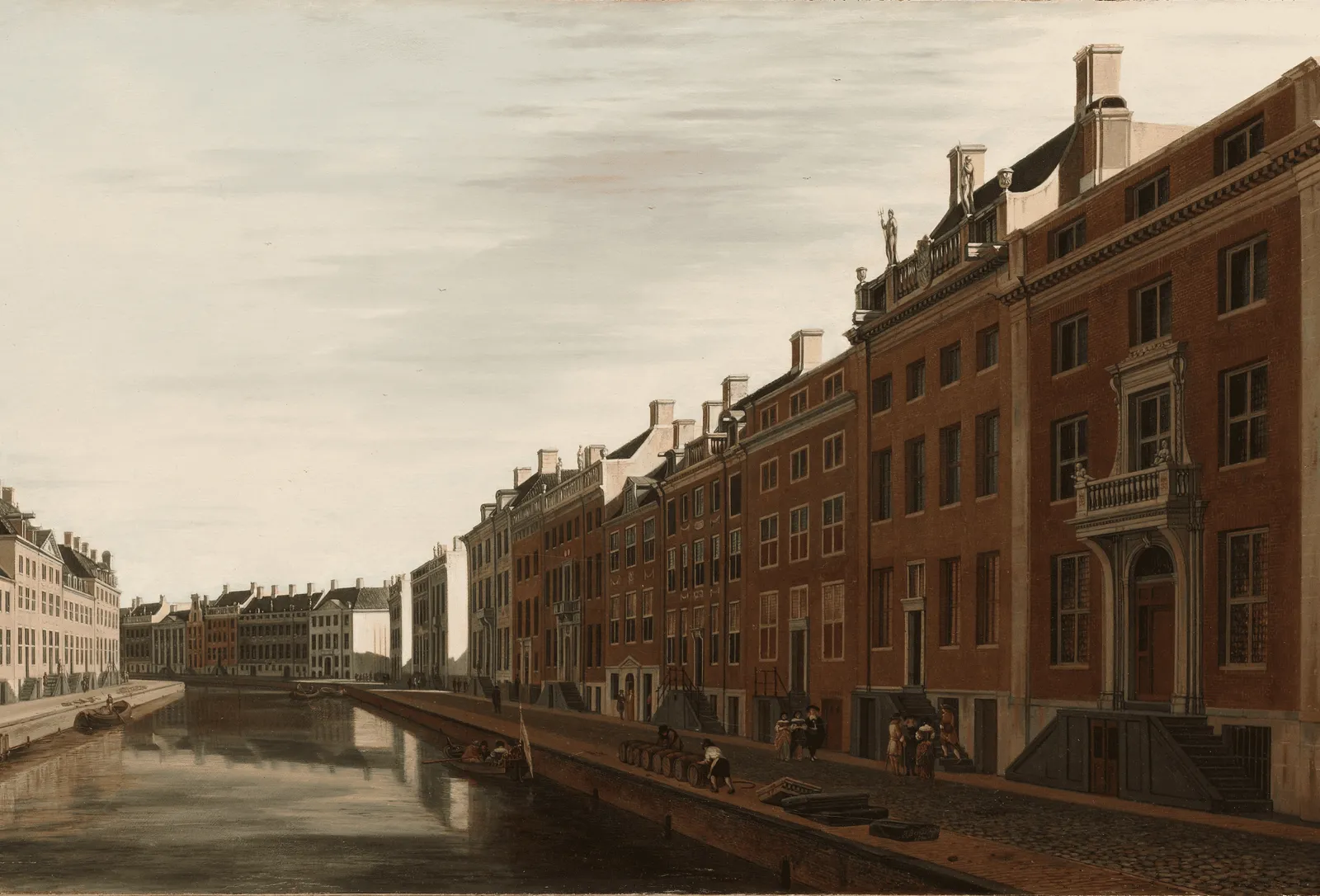
Historical painting of Amsterdam's Golden Bend canal with brick merchant houses and figures on the quayside

The Golden Bend as painted by Gerrit Berckheyde in the 1670s — the same façades still stand today.

The Golden Bend — Gouden Bocht — is the grandest stretch of the Herengracht, where Amsterdam's wealthiest families built their homes. Unlike the narrow canal houses elsewhere in the city, they could buy double plots and build enormous town palaces, often with gardens hidden behind them. Amsterdam City Archives

Look closely from the water and you can see the difference: wider façades, grand entrances, classical cornices and far more elaborate architecture. These weren't just houses — they were 17th-century status symbols. Some of the city's most powerful merchants, mayors and VOC directors lived here. Rijksmuseum

And the Golden Bend was impressive even when it was brand new. Painter Gerrit Berckheyde captured the freshly built houses from the water in the 1670s, giving us an almost perfect glimpse of Amsterdam's elite neighbourhood during the Dutch Golden Age. Rijksmuseum

Today, the façades are still there. The world around them isn't. That's what makes a VR canal cruise particularly fun here. VR Voyage lets you look at Amsterdam from the water while virtually stepping back 400 years — seeing the city as it might have appeared during the Dutch Golden Age, then taking the headset off and seeing the same streets and canals as they are today. It's one thing to cruise past the Golden Bend. It's another to see the world that built it.

VR Voyage RondvaartShared cruise
VR Voyage Rondvaart

€37.5per person

Up to 241 hour 15 minutesRain protected
Tue22Sep
Today
Wed23Sep

Amsterdam Bankers and the American Revolution

At Herengracht 386, now the Museum of the Canals, Amsterdam's wealth connects directly to American history. The house was commissioned in 1663 by merchant Karel Gerards and designed by Philips Vingboons, one of the leading architects of the period. A later owner, banker Jan Willink, helped finance the American Revolutionary War: with two colleagues, he lent money to John Adams, later the second president of the United States. Spread out over 5 loans the total financing was about $12 million dollars at the time. In today's equivalent that would be about 22 billions USD!

It is a precise example of how the fortunes made along Amsterdam's canals reached far beyond the city, according to the Museum of the Canals.

Shared Cruise on the SophieShared cruise
Shared Cruise on the Sophie

€55per person

Up to 121 hour & 30 minsRain protected
Tue22Sep
Today
Wed23Sep
Tomorrow
Thu24Sep
Fri25Sep
Sat26Sep
More info →

Prêt à réserver votre croisière à Amsterdam ?

Comparez 70+ bateaux vérifiés auprès d’opérateurs locaux — privés et partagés.

Découvrir les croisières

Questions fréquentes

Many canal houses lean slightly forward by design — to allow goods to be hoisted to upper floors without hitting the façade. The hook and pulley visible at the top of most houses was used to lift furniture and goods through the upper windows, which were often wider than the staircases inside.
The narrowest canal house in Amsterdam is at Singel 7, measuring approximately 1 metre wide at its narrowest point. It was originally a doorway to a larger property behind it. The Keizersgracht also has several houses in the 3–4 metre width range.
Yes. Museum Van Loon (Keizersgracht 672) and Willet-Holthuysen Museum (Herengracht 605) are both preserved Golden Age canal houses open to the public. Museum Het Schip and the Multatuli Museum are also worth visiting for different architectural periods.
Amsterdam has approximately 8,000 listed national monuments, of which the majority are canal houses in the UNESCO ring. The Netherlands has the highest concentration of listed urban monuments of any country in Europe.

Réservez une croisière sur les canaux

Shared Cruise on the Sophie
Shared Cruise

Shared Cruise on the Sophie

View cruise
Shared Off The Beaten Path, Hidden Gems Canal Cruise
Shared Cruise

Shared Off The Beaten Path, Hidden Gems Canal Cruise

View cruise
Amsterdam Historic Boat Tour
Private Cruise

Amsterdam Historic Boat Tour

View cruise
VR Voyage Rondvaart
Shared Cruise

VR Voyage Rondvaart

View cruise

Guides recommandés

🗺️
Neighbourhoods & Routes

Amsterdam Canal Route Guide: The Best Routes by Boat

Amsterdam has over 100 kilometres of canals divided into distinct zones, each with a different chara…

Read guide 3 min
🗺️
Neighbourhoods & Routes

Canal Cruise Through the Jordaan, Amsterdam

The Jordaan is Amsterdam's most sought-after neighbourhood for a reason: narrow streets, intimate ca…

Read guide 3 min
🗺️
Neighbourhoods & Routes

UNESCO Canal Ring Boat Tour Amsterdam

Amsterdam's Grachtengordel — the semicircular belt of canals built between 1613 and 1665 — was inscr…

Read guide 3 min
← Retour à tous les guides d'Amsterdam
Sun
27
Sep
Mon28Sep
Tue29Sep
Wed30Sep
Thu1Oct
More
dates
Tomorrow
Thu24Sep
Fri25Sep
Sat26Sep
Sun27Sep
Mon28Sep
Tue29Sep
Wed30Sep
Thu1Oct
More
dates
More info →
Sun
27
Sep
Mon28Sep
Tue29Sep
Wed30Sep
Thu1Oct
More
dates